


Artificial intelligence has moved from an emerging technology to a serious business consideration. In 2026, organisations across financial services, healthcare, retail, engineering and other sectors are exploring how AI can improve efficiency, support better decisions and create new opportunities.
But adopting AI is not the same as having an AI strategy.
Buying a collection of AI tools, introducing a chatbot or asking employees to experiment with generative AI does not necessarily create business value. Without a clear direction, organisations can end up investing in disconnected technologies, exposing sensitive data to unnecessary risks, or running AI projects that never move beyond experimentation.
A well-designed AI strategy provides a structured way to decide where AI can create meaningful value, what needs to be in place before implementation, and how investments should be prioritised.
For organisations considering AI adoption, the question is no longer simply “Can we use AI?” It is “Where should we use AI, why should we use it, and how can we implement it responsibly?”
What is an AI strategy?
An AI strategy is a structured plan that explains how an organisation will use artificial intelligence to support its business objectives.
Rather than beginning with a particular AI tool or technology, a business-first strategy starts by understanding the organisation itself: its objectives, processes, customers, data, technology, people and risks.
A practical AI strategy should answer questions such as:
- Where can AI create measurable business value?
- Which business processes are suitable for AI?
- What data is available, and can it be trusted?
- What technology and infrastructure are required?
- What risks could AI introduce?
- How should employees work alongside AI systems?
- Which AI initiatives should be prioritised?
- How will the organisation measure success?
- What governance and oversight will be required?
Answering these questions helps businesses avoid adopting AI simply because competitors are doing it.
Why is an AI strategy important?
AI can have a significant impact on how organisations operate, but successful adoption requires more than technology.
An effective strategy connects AI initiatives to specific business objectives and provides a framework for deciding where investment should go.
- Identify where AI can deliver genuine value
Not every process needs AI.
Some organisations start by looking for opportunities to introduce the latest AI technology and then try to find a problem for it to solve. A better approach is to start with the business problem.
For example, an organisation may have processes involving:
- Large volumes of documents
- Repetitive administrative work
- Customer enquiries
- Data analysis
- Forecasting
- Manual reporting
- Knowledge retrieval
- Quality control
- Operational monitoring
These processes may present opportunities for AI, but the business case needs to be assessed before implementation.
A structured AI strategy consulting approach can help organisations assess potential use cases, estimate their value, understand implementation requirements and prioritise initiatives according to impact, cost and risk.
- Improve employee productivity
Many employees spend significant amounts of time on repetitive activities such as searching for information, preparing documents, processing requests, summarising content and responding to routine enquiries.
AI can assist with many of these activities and give employees more time for work that requires judgement, creativity, problem-solving and relationship management.
The objective should not be to introduce as many AI tools as possible.
Instead, organisations should ask:
How can AI remove unnecessary manual work while keeping people in control of important decisions?
That distinction matters. AI should support employees rather than automatically replace human judgement, particularly when decisions have significant financial, legal, operational or customer consequences.
- Make better use of business data
Businesses generate enormous amounts of data, but collecting data is only part of the challenge.
Organisations need to be able to access, understand and use that information effectively.
AI can help identify patterns, analyse large datasets, support forecasting and provide faster access to relevant information. Potential applications include customer analysis, demand forecasting, operational analytics, inventory management and decision support.
However, the quality of an AI system is closely connected to the quality and accessibility of the data behind it.
That is why an AI strategy should consider data readiness before an organisation commits to large-scale implementation.
- Improve customer experiences
Customer expectations continue to change. People increasingly expect organisations to provide quick, relevant and convenient experiences.
AI can support this through applications such as:
- Intelligent customer support
- Automated responses to routine enquiries
- Personalised recommendations
- Faster information retrieval
- Customer segmentation
- Predictive insights
However, automation should not mean removing human interaction altogether.
A well-designed customer experience can use AI to handle straightforward requests while allowing complex or sensitive issues to be escalated to an employee.
The goal is to create the right balance between automation and human expertise.
- Make AI investments more effective
Implementing AI requires investment.
Businesses may need to consider software, infrastructure, data preparation, integration, security, employee training, governance and ongoing monitoring.
Without a strategy, organisations can accumulate multiple subscriptions and disconnected proof-of-concept projects without understanding whether they are generating meaningful returns.
An AI strategy creates a framework for prioritising investment.
Before implementation, organisations should define:
- The business problem being addressed
- The expected benefits
- The required investment
- The implementation timeline
- Key performance indicators
- Potential risks
- How the results will be evaluated
This makes AI investment easier to manage and gives leadership teams a clearer view of progress and return on investment.
- Build an AI roadmap
Knowing that AI matters is not enough. Organisations also need to know what to do next.
A practical AI roadmap can establish priorities over the short, medium and longer term.
For example, an organisation might begin with an assessment of its current capabilities and data, identify several potential use cases, select a small number of high-value initiatives and then develop the technical foundations required to scale them.
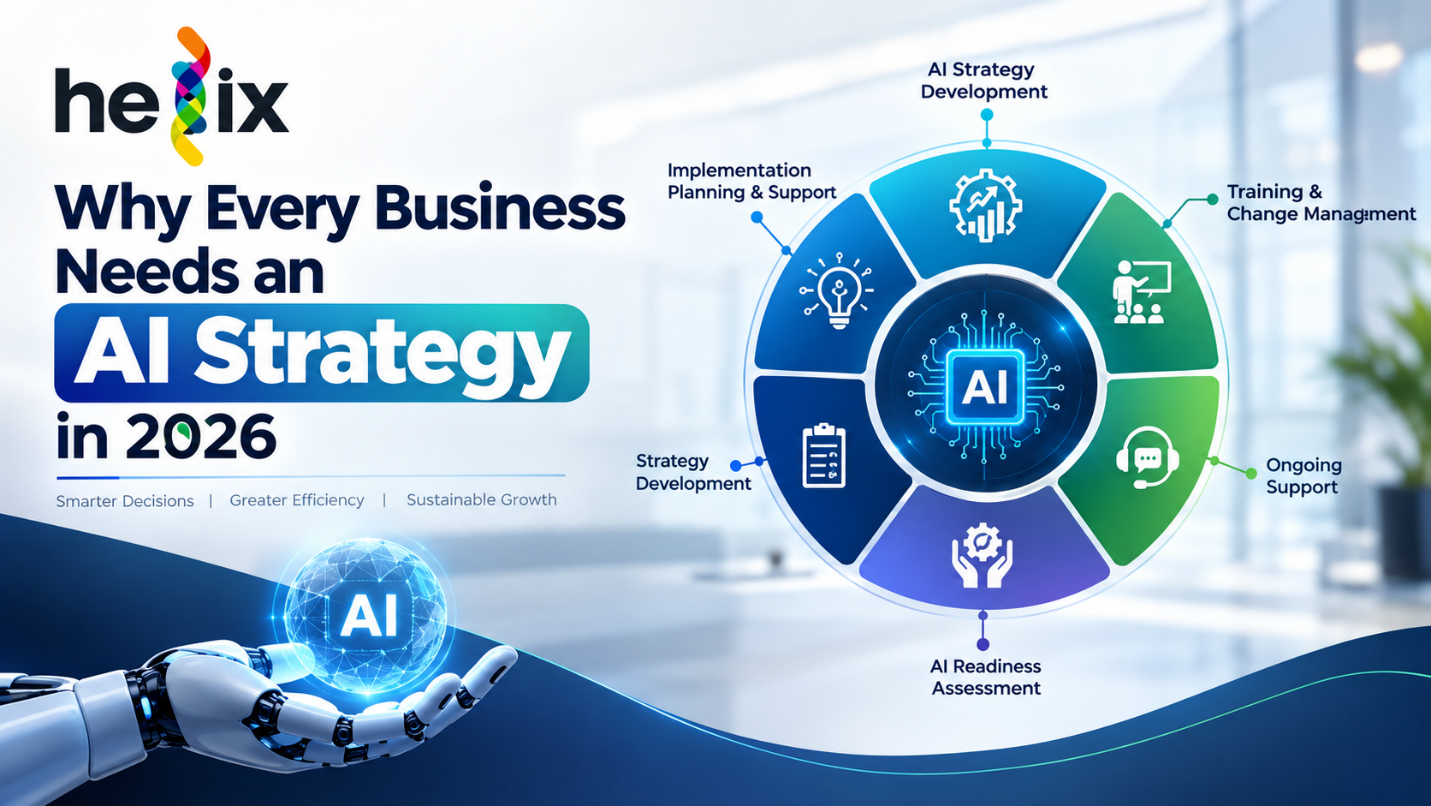
Helix TS approaches AI strategy by assessing current capabilities, data, tools and skills, identifying realistic use cases, prioritising initiatives based on impact and risk, and developing a AI roadmap with clear milestones.
This type of roadmap helps move an organisation from isolated AI experiments towards a coordinated programme of adoption.
Data readiness comes first
AI depends on data.
If information is incomplete, inconsistent, inaccessible or poorly governed, an AI project can struggle regardless of how advanced the underlying technology is.
Before implementing AI, organisations should understand:
- What data they have
- Where the data is stored
- Who can access it
- How it is managed
- Whether it is accurate and complete
- How sensitive information is protected
- Whether the organisation can use the data for its intended purpose
Data security is particularly important when AI systems interact with confidential business, customer or employee information.
For this reason, data readiness and security should be considered as part of AI planning rather than treated as an afterthought.
AI architecture matters too
Once an organisation knows which AI initiatives it wants to pursue, it needs the right technical foundations to support them.
AI architecture can involve data ingestion, applications, models, integrations, security, access controls, monitoring and ongoing management.
A solution that works as a small proof of concept may not necessarily be suitable for production or future growth.
This is where AI architecture and solution design become important. Helix TS works with organisations to consider how data, models and applications should work together, while also considering security, scalability, technology selection and monitoring.
The objective is to build an architecture that can support real-world use rather than creating a one-off experiment that becomes difficult to maintain.
AI governance and risk cannot be ignored
AI creates opportunities, but it also introduces risks.
These can include:
- Inaccurate or unreliable outputs
- Data privacy concerns
- Security vulnerabilities
- Intellectual property issues
- Regulatory requirements
- Lack of transparency
- Over-reliance on automated decisions
- Poorly controlled third-party AI tools
An AI strategy should therefore include appropriate governance from the beginning.
Organisations need clear processes for deciding which AI use cases are acceptable, how systems are monitored, who is accountable for decisions and how sensitive data is protected.
Helix TS provides AI governance and advisory services covering areas such as governance frameworks, model monitoring, explainability, data protection, approval processes and board-level reporting. Good governance does not have to prevent innovation. Instead, it can provide organisations with the controls they need to adopt AI responsibly and confidently.
AI should support people, not remove human judgement
One of the most important considerations in an AI strategy is the relationship between people and technology.
AI can process information quickly and automate certain activities, but businesses still need human oversight.
Employees should understand:
- When AI can be trusted
- When outputs need to be checked
- Which decisions require human approval
- How sensitive information should be handled
- What to do when an AI system produces an unexpected result
The right approach will vary between organisations and use cases. A customer-facing recommendation system, for example, may require a different level of human oversight from an AI system supporting a high-impact business decision.
An effective AI strategy takes these differences into account.
How should a business start developing an AI strategy?
Businesses do not need to begin with a large-scale AI transformation programme.
A sensible starting point is to understand the current situation and identify where AI could provide measurable value.
A practical process can include:
Step 1: Understand business objectives
Start with the organisation’s strategic and operational goals.
What problems are affecting growth, efficiency, customer experience or decision-making?
Step 2: Assess current technology and data
Review existing systems, software, data sources, infrastructure and internal capabilities.
This can highlight technical constraints that need to be addressed before AI implementation.
Step 3: Identify AI use cases
Map potential AI applications to genuine business problems.
Not every idea needs to become a project.
Step 4: Prioritise opportunities
Evaluate potential initiatives according to factors such as business value, complexity, cost, risk, data availability and implementation requirements.
Step 5: Create an AI roadmap
Turn the prioritised initiatives into a practical roadmap with defined milestones, responsibilities and measures of success.
Step 6: Establish governance
Define the policies, controls and oversight required to manage AI responsibly.
Step 7: Implement and measure
Move selected initiatives into delivery and continuously evaluate their performance against agreed business objectives.
This approach allows businesses to learn from early initiatives while building towards a scalable AI capability.
Do businesses really need an AI strategy in 2026?
The answer depends on the organisation, its objectives and how extensively it intends to use AI.
A small business experimenting with a single low-risk productivity tool may not require the same level of strategic planning as a large organisation deploying AI across customer operations, financial processes or sensitive data.
However, as AI becomes increasingly embedded in business operations, having a clear framework for evaluating opportunities, managing risk and prioritising investment becomes increasingly valuable.
The purpose of an AI strategy is not to put AI everywhere.
It is to identify where AI makes sense, where it does not, and how to implement the right solutions effectively and responsibly.
Conclusion
AI can help organisations automate repetitive work, make better use of data, improve customer experiences and support faster decision-making. But technology alone does not guarantee business value.
Successful AI adoption starts with understanding the organisation, identifying meaningful use cases, assessing data and technology readiness, establishing appropriate governance and creating a realistic roadmap for implementation.
For businesses considering their next step, an AI strategy provides a way to move beyond experimentation and make informed decisions about where AI can genuinely contribute to business objectives.
At Helix Technology Solutions, we combine AI strategy consulting, architecture, implementation and governance to help organisations move from ideas to practical, measurable AI solutions.
If your organisation is exploring how AI could support its business goals, the first step is not necessarily choosing a tool. It is understanding where AI can create the greatest value and building a plan to get there.
Frequently Asked Questions
What is an AI strategy?
An AI strategy is a structured plan for how an organisation will use artificial intelligence to support specific business objectives. It typically covers AI use cases, data readiness, technology, governance, people, implementation priorities and measures of success.
Does every business need an AI strategy?
Not every business needs to adopt AI in the same way. However, organisations considering multiple AI initiatives can benefit from a strategy that helps them identify valuable use cases, prioritise investment and manage risks.
How do you create an AI strategy?
An AI strategy typically starts with understanding business objectives and assessing existing technology, data and capabilities. Organisations can then identify and prioritise AI use cases, develop an implementation roadmap, establish governance and define how success will be measured.
What are the risks of using AI without a strategy?
Using AI without a clear strategy can result in wasted investment, disconnected projects, data privacy concerns, security risks, unreliable outputs and governance gaps. A structured strategy helps organisations establish appropriate controls and focus investment on use cases that align with business objectives.